Showing posts with label Estée Lauder. Show all posts

Friday, February 6, 2015

The newest face of cosmetics: A social media star

Kendall Jenner has proven herself to be more than Kim Kardashian's half-sister. Last November, the social media it girl was named the new face of global luxury brand Estée Lauder. The details of her contract have remained undisclosed, but as it is known in industry circles, a cosmetics deal is considered the Holy Grail of modeling.
Image Source: usmagazine.com

As the beauty brand’s newest brand ambassador, Kendall joins the ranks of Carolyn Murphy, Elizabeth Hurley, and Karen Graham, the legendary "Estée Lauder Woman." Although the decision to sign Jenner in did not lend as much prestige and sophistication to the brand as the above-mentioned models did in the past, it was a very strategic and commercially viable move for the 69-year-old brand.
Image Source: 15secondsofpop.com

A sprawling room for reinvention is what Jenner offers best as the newest face for the timeless brand. For one, her combined followers over Twitter, Facebook, and Instagram add up to 30 million, allowing the makeup brand to reach more consumers than simply putting out a glossy spread in a magazine. Jenner's fan base comprises of teenage girls and twenty-something career women who think getting her fresh, fierce, and selfie-ready look is the ideal way to doll themselves up. Hence, by introducing the brand to Jenner's legions of social media followers, Estée Lauder can anticipate sales to go notches higher than in the past decades.
The timing is also perfect: although its sales remain impressive, the consumer base of Estée Lauder Companies’ flagship brand is getting older, as younger women prefer the beauty conglomerate's relatively newer product lines such as MAC, Bobbi Brown, and Clinique (although ladies of the '90s who swore by its three-step system are definitely not getting any younger, too).
Image Source: sundaygirl.com


Social media's influence to today’s buyers is undeniable, as the Jenner-Estée Lauder partnership demonstrates. Thus it will come as no surprise if more social media superstars will be tapped in the future to add some refreshing touch to the campaigns of makeup and skincare brands millions of women have dearly kept in their beauty arsenals.
William Lauder, executive chairman of Estée Lauder Companies, has been instrumental in the launch of innovative campaigns and strategies for the conglomerate’s multibillion-dollar beauty brands. Follow this Twitter account for the latest updates on the global luxury beauty market.

Tuesday, January 20, 2015

Strengthening the brand: Estée Lauder’s newest beauty acquisitions

From the period of October to December 2014, Estée Lauder Companies Inc. acquired two luxury brands: Rodin Olio Lusso, a skincare company with a potent face oil as its flagship product, and Le Labo, a high-end fragrance brand. In January 2015, the company finally completed its acquisition of the ultra-luxury fragrance brand, Editions de Parfums Frédéric Malle and the Hollywood skincare brand, GlamGlow.

Image Source: cafemakeup.com

The acquisition spree was a dynamic momentum since the company’s hiatus in mergers and acquisitions in 2010 with Smashbox as its last takeover during that time. This focus on promoting luxury brands means that the company continues to target a very high-end customer base.

Image Source: tickrwatch.com

Estée Lauder has been known in developing small brands into influential ones that drive the luxury beauty market. Its recent acquisitions are a way of maintaining high-end customers and attracting potential converts to luxury product lines. Estée Lauder is in a great position to grow the brands and strengthen their place in the beauty business.


Image Source: forbes.com
This is what William Lauder, executive chairman of The Estee Lauder Companies, stressed during the acquisition of Le Labo. “Entrepreneurship is at the heart of our Company’s heritage. One of the leading strengths of our Company is our ability to identify brands with unique positioning and nurture them to accelerate their momentum and realize their full growth potential.”

Clearly, Estée Lauder not only strengthens its image and reputation but it also helps the acquired brands to attract high-end customers ensuring a mutual benefit.

William Lauder, executive chairman of The Estée Lauder Companies, considers growth in the luxury beauty business with its recent acquisition of high-end brands such as Rodin Olio Lusso, Le Labo, Editions de Parfums Frédéric Malle, and GlamGLow. Visit this Twitter account to see latest updates on the global luxury beauty market.

Thursday, November 6, 2014

REPOST: Estée Lauder Acquires Rodin Olio Lusso

Beauty company Estée Lauder ended October with not just one, but two acquisitions. After announcing its purchase of perfume maker Le Labo on October 15, the cosmetics giant closed the month with the purchase of skincare company Rodin Olio Lusso. Fashionista.com’s Eliza Brooke has the details below:  
Image Source: fashionista.com


After inking a deal to acquire Le Labo just a few weeks ago, Estée Lauder has added one more blue chip brand to its portfolio: Rodin Olio Lusso, the skincare company founded by stylist Linda Rodin whose flagship face oil has been winning over beauty aficionados since 2007. Not only is it Estée Lauder's second acquisition in the last month, but it's the second since the brand acquired Smashbox in 2010, ending a significant M&A dry spell.

The terms of the deal have not been disclosed, nor did a rep for the company respond to a question about Rodin Olio Lusso's sales figures over the last few years. Le Labo, which occupies a similarly known-but-niche spot in the beauty industry, reportedly generates $20 million to $30 million in sales each year.

Le Labo and Rodin Olio Lusso share a certain cushy status. Favorites of fashion and beauty editors, they seem niche but are ubiquitous in the press and are expensive but not as unaffordable as a brand like La Mer (also an Estée Lauder portfolio company). While Le Labo operates its own mixologist-type shops, Rodin Olio Lusso has a home at stores like Barneys, Colette and Liberty. Of course, it helps that Linda Rodin has been in the fashion industry as a model and stylist for quite a long time -- and that at 65, she is the pinnacle of aging with style.

As Estée Lauder President and CEO Fabrizio Freda put it in a statement, "Rodin Olio Lusso is the ultimate ‘insider’ beauty brand," noting that the team believes "it has the potential to be a high-growth global skin care brand that strategically enhances our portfolio." Basically: There's a lot of brand equity happening here, but not too much scale. Yet.
If this shopping spree continues, we'll be watching to see who Estée Lauder poaches next.


The recent acquisitions of Estée Lauder Companies further strengthen the conglomerate’s reign over the global beauty market, something that William Lauder vowed to uphold when he took the helm as executive chair. Learn more about the growing family of ELC here.

Wednesday, June 4, 2014

REPOST: Estée Lauder chairman: Focus expansion efforts on where the future might be

William P. Lauder, executive chairman of Estee Lauder Companies, discusses in this Luxury Daily article the firm’s expansion efforts, especially in emerging markets, and how these ventures will further boost the brand’s retail strategy.

MEXICO CITY, Mexico – Estée Lauder Cos.’ expansion practices are marked by entering emerging markets ahead of other companies despite the increased risk, according to the “Building Empire” session May 13 at the FT Business of Luxury Summit.

Estee Lauder’s Pure Color Envy lipsticks  | Image source: luxurydaily.com

Understanding risk tolerance is a must when embarking on any new project, especially when setting up shop in marketplace that is still developing. As one of the world’s most valuable brands, Estée Lauder strives to introduce its products ahead of competitors to better understand emerging markets.

“Beauty is the entry point of luxury in every circumstance,” said William P. Lauder, executive chairman of Estée Lauder Cos., New York.

“Our brands are global,” he said. “But our consumers are global, too.
“We look to gateway cities around the world that represent the best of what our brand has to offer. These are cities such as Paris, London, New York and maybe even Hong Kong now.”

Boundless beauty

Estée Lauder, founded by Mr. Lauder’s parents in 1948, set the pace for establishing a presence in emerging markets.

When the brand was launched after the Second World War, the United States was essentially an emerging market that had rapidly evolved from an post-agricultural, industrial society to what we see today.
As the U.S. grew, so did Estée Lauder. By 1960, the brand entered the United Kingdom, Japan in 1966 and Mexico in 1970.

Mr. Lauder explained that this business model has allowed Estée Lauder to scale to where it is today.


Estée Lauder‘s summer 2014 Bronze Goddess collection | Image source: luxurydaily.com

When entering a market that other brands may have been hesitant to enter, Estée Lauder looks to inspire the rising middle class woman to treat herself well. Compared to other luxury categories, beauty products are more accessible.
The cosmetics brand has steadily followed the rise of the middle class consumer.
For instance, in 1989, after the collapse of the U.S.S.R, Estée Lauder was the first Western brand available for purchase in Russian rubles.

To get a sense of Estée Lauder’s success in emerging markets, Mr. Lauder said that in 1996, 60 percent of sales were from North America comprising Canada and the U.S. Today, in comparison, 70 percent of sales come from outside North America.

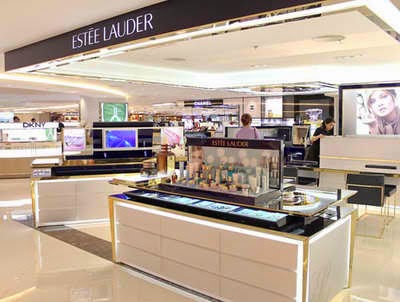
An Estée Lauder beauty counter | Image source: luxurydaily.com

This has been accomplished by matching Estée Lauder brands to the local market place. Estée Lauder evaluates how and where the consumer prefers to shop and travel to determine the best retail strategy.

For instance, Estée Lauder’s M.A.C brand is one of its most successful in emerging marketplaces. The brand is especially popular in Brazil where there are M.A.C boutiques, but the bricks-and-mortar location in New York’s Times Square has a consumer base that is 40 percent Brazilian.

To better serve these consumers – who are mostly tourists – at this location, as well as shops in Miami, Estée Lauder hires Portuguese-speaking sales associates to work at the store.
This is similar to Australian locations, where M.A.C products sell better if there is a Mandarin-speaking sales associate to accommodate the high number of Chinese travelers.

In China, there is no true domestic beauty brand, thus imports are stronger and more popular.
Estée Lauder aims its business at the top 10-15 percent of Chinese consumers, a group roughly larger than its European base.

By entering the marketplace earlier than others in 1993, Estée Lauder secured a relationship with Chinese consumers. As the middle class grew and women began having more disposable income, Estée Lauder saw its return on investment.

Estée Lauder‘s Chinese Web site | Image source: luxurydaily.com

Interestingly, Estée Lauder’s fourth-best selling store is a Macy’s, located in New York’s Flushing, Queens, neighborhood.

Dubbed as “Little Hong Kong,” by Mr. Lauder, the residents of the neighborhood look to Macy’s beauty counter to purchase Estée Lauder products to ship to relatives and friends in China to avoid the high import duties.

This demographic is not consistent in every region.

For example, in London’s Knightsbridge neighborhood, Estée Lauder sees a high percentage of Middle Eastern consumers during the summer months, but this has started to be disrupted.

Estée Lauder counters at retailers such as Harrods and Selfridges have seen a rise in Nigerian consumers. Harrods lists Nigerian consumers among the department store’s top 10 spenders.

Mr. Lauder stated that Estée Lauder is beginning to invest in Sub-Sahara Africa in countries such as Kenya and Nigeria. This region of the world, due to its high concentration of wealth from the oil industry, is the next frontier for the beauty marketer with bricks-and-mortar boutiques slotted for Lagos.

Digital beauty

While Estée Lauder prides itself on its aspirational model and high price points, it has also been able to interact with the consumer where she wishes to shop, which is increasingly online.

Lancôme Paris, Kiehl’s and L’Oréal Paris clinched the top three spots in L2 Think Tank’s “Digital IQ Index: Beauty 2013″ study as competition escalates on a variety of fronts. Although L’Oréal Group grabbed the top three finish, Estée Lauder had five brands in the top ten and the highest average digital IQ for its 11 brands at 119 (see story).

Mr. Lauder explained that the brand now tests the water using ecommerce. He also noted that since ecommerce was launched in 1997, the brand sees more click-throughs for the store locator than shopping carts.

This shows the fundamental change in consumer behavior, but also supports Estée Lauder’s success at creating a model conducive to how enthusiasts wish to shop.

“In our industry, most of our competitors are similar in capital,” Mr. Lauder said.

“[Estée Lauder] is more patient,” he said. “We’ve seen a nice return by being patient and entrepreneurial.”


William Lauder’s vision for Estee Lauder Companies solidifies further the company's leadership in the beauty market. Follow this Facebook page to learn more about ELC's upcoming business ventures.